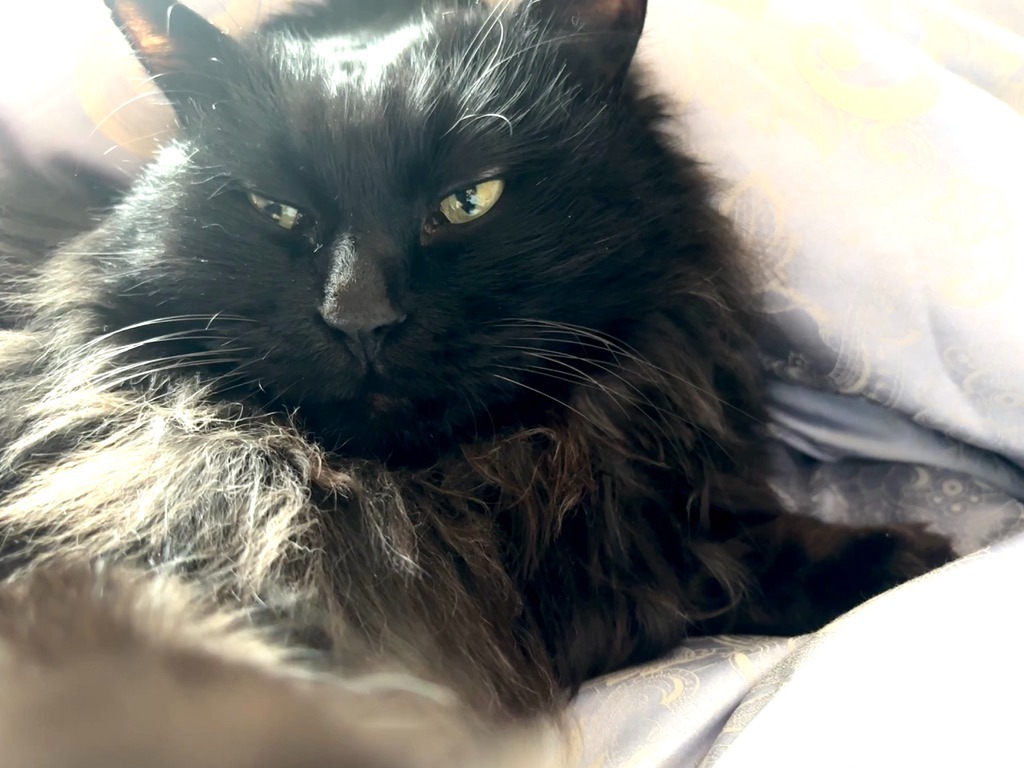
“Lulu knocked over her bowl again. Cat food is all over the living room floor,” I sighed into the phone. “And this time it was the ceramic one with the gold trim. It broke into several pieces, like a puzzle.”
My friend paused for two seconds. “You’re smiling.”
“I’m not.”
“You are. Every time you talk about your cat making a mess, you try to sound annoyed, but your voice turns sweet. I honestly can’t be with you.”
I lowered my head toward the shadow by my feet. Nine years have passed, and this little patch of black fur that once fit in my palm has grown into a twelve-pound weight of fluff.
In the winter of third grade, my parents brought her home in a perforated cardboard box. At that age, school and home were my whole world, and both felt equally fragile. I had just gotten one of the lowest test scores of my life, and I was still carrying that heavy feeling, the kind that made me want nothing more than my familiar home and the people in it.
But when I opened the door, the world I knew had shifted. Without warning, this tiny black kitten had taken my place. My parents circled around her, laughing, calling her name, showing her the little toys they bought. They spent the whole afternoon preparing her bed, her food, her litter box. No one even noticed the crumpled test paper in my hand.
To my eight-year-old self, it felt as if she had arrived instead of me. If she had come into our home for my sake, then why was I the one left standing on the outside? Why did her soft “meow” pull everyone’s attention away so easily?
I hated her for that. And even more, I hated the way she was cute and gentle and impossibly easy to love. It felt unfair that something so small and perfect could walk into my home and rearrange the entire center of gravity without even trying.
So from the very beginning, I never spoke kindly to her.
“Move. You’re blocking the TV.”
“Don’t rub on me. You shed everywhere.”
“You’re so dumb. You can’t even catch the teaser wand.”
Speaking harshly became a habit. I acted as if that could hide a truth I did not want to admit. The truth was that the first time she jumped onto my bed, curled by my feet and started purring, something inside me softened without permission. Nine years ago, she was only the size of my palm. Now she weighs twelve pounds. When she sleeps on my chest, her warmth feels steady and comforting. Over the years we grew up together. My annoyed comments never stopped, and her quiet companionship never stopped either.
If she is well-behaved, then she truly is, in a way that makes your heart hurt a little. On the day she came home, she already knew how to use the litter box and never made a mistake. She eats in small bites, chewing each piece of kibble, delicate as if she is tasting tea. She seems to understand my harsh words, yet at the same time it feels like she does not understand them at all. Otherwise, why would she place her favorite toy mouse beside my hand when I cry? Why would she stay under the desk lamp and keep me company until dawn as I study?
When she feels sick, she never cries. When something hurts, she does not complain. She simply hides in a corner and lies very quietly, her breath so light it is barely there. I sometimes wish she were more spoiled. If she scratched the sofa, knocked over a vase or ran around at four in the morning, at least I would know she felt free to express herself. But she is always too well-behaved. She is so well-behaved that it scares me. I often worry she might be enduring something silently without us noticing.
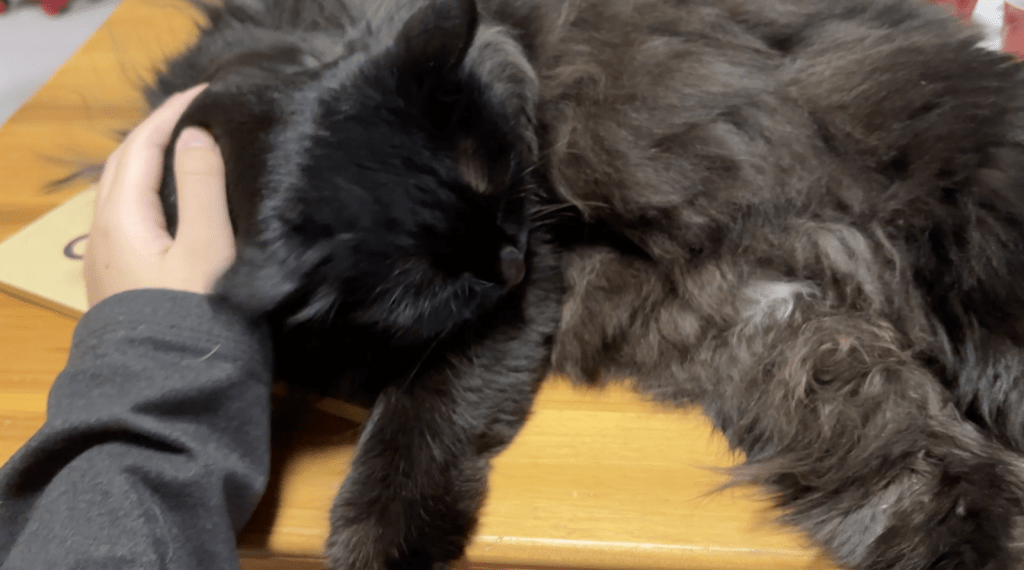
A few days ago, I noticed something I had never seen before. As she rolled onto her back, a small patch of white hair stood out sharply against the darkness of her fur. It was just a thin cluster of strands, but the contrast was unmistakable. That single flash of white made me stop. It made me think. It made me afraid. I suddenly realized she was aging, quietly and quickly, and I began to wonder how many more years she could stay by my side.
I turned toward her and pressed my face into the fur on her back.Tears slipped out before I even noticed. She moved slightly but did not wake up. Instead, she gently placed a paw on the back of my hand. Her paw pad felt soft and warm.
Thank goodness she cannot understand human language. She cannot understand the “go away” or the “stop bothering me,” and she cannot understand the late-night whispers of “don’t leave,” “stay with me a little longer,” or “I’m sorry.” She carries all my contradictions without question. She accepts my dislike and my dependence, my pushing away and my reaching for her, always in the same steady way she has had for nine years. No matter how harsh my words are, she follows behind me like a small shadow that gives off warmth.
Love sometimes works like this. You think you are complaining that she broke your favorite bowl, but what you truly mean is that she is still lively and still full of spirit. You think you resent tripping over her in the dark, but deep down you are grateful that she is always there. You think your harsh words were sincere, but they were really a child’s clumsy fear, the fear of loving something that will eventually leave.
What moves me the most are her moments of complete trust. In the afternoon sunlight, she stretches herself across the carpet like a black blanket, her belly exposed as she gently brushes her face with her paw. I crouch beside her, my hand hovering above her fur. She opens her eyes, now amber instead of the soft gray-blue she had as a kitten, and after a brief look, closes them again with a quiet purr. It feels like an invitation.
My fingers touched her cheek, moved along the grain of her fur and brushed past her whiskers. My thumb reached her cool, damp nose. Then my hand rested on her chest, where I felt the faint but steady rise and fall. One breath, then another. I once resisted letting this small life enter my world, and now I fear losing her with the same intensity.
She is aging faster than I had prepared myself for. Those few white hairs made my chest tighten. Nine years had passed not only for me, but for her as well.
In The Little Prince, it says that you are forever responsible for what you have tamed. I did not understand this when I was a little girl. Now, holding this black cat who has spent nine years taming me, I finally understand. Responsibility does not begin when you admit you love someone. It begins the moment you let them into your life. Perhaps all those harsh words were simply my younger self’s clumsy attempt to avoid carrying the weight of loving something fragile. Loving someone is harder than hating, and continuing to love them requires more courage. It takes courage to face the possibility of loss, and courage to face the parts of yourself that once failed to be gentle.
My friend was still talking. “You’re absolutely in love with her, aren’t you?”
I did not answer. The shadow at my feet stood up, stretched in a long, slow arc and walked toward the living room with her tail held high. I followed her and saw the sunlight falling across the broken pieces of porcelain, scattering tiny reflections everywhere. Lulu sat right in the middle of the light and began grooming herself.
“Hey,” I said into the phone. “I need to go sweep.”
“Cleaning up after her again?”
“Yes.” I looked at the black ball of fur, my voice softer than before. “What else would I do?”
 Amy's Memoir