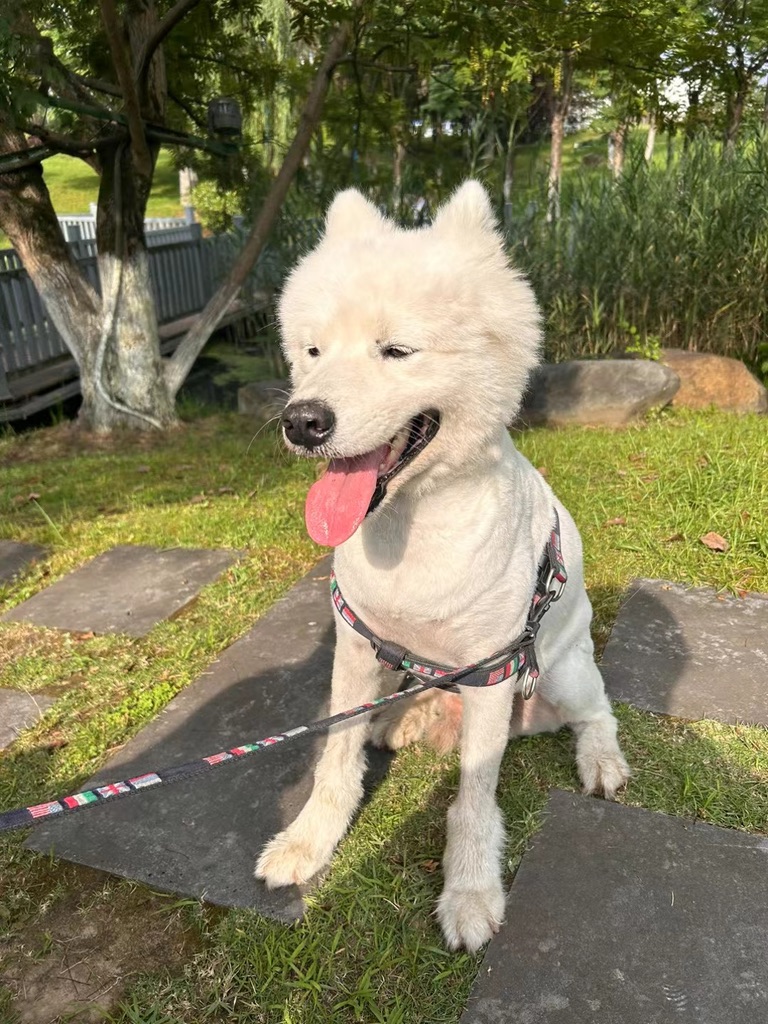
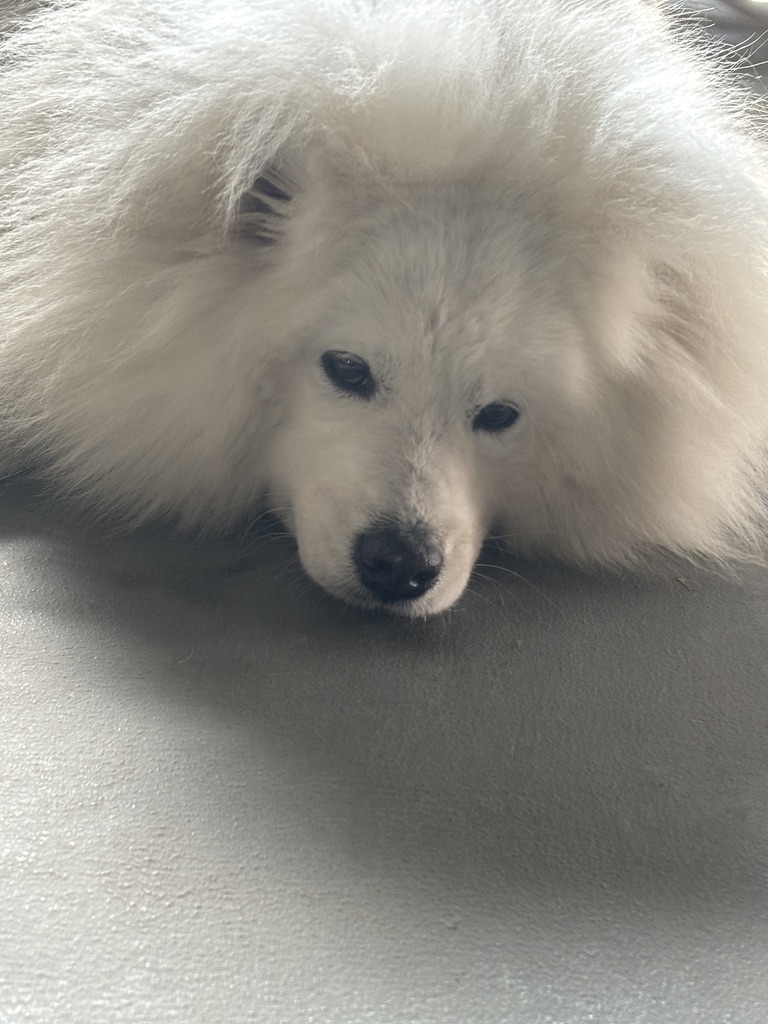
His name is Xiaobai.
The fattest Samoyed in the world.
That’s how we always introduced him. Making jokes about his weight was easier than explaining that someone hadn’t wanted him anymore.
He arrived when he was a little over a year old. Technically an adult dog, but his fur had been shaved off because of a skin condition. Without that fluffy white coat, he looked thin and small. Almost pitiful. Standing there like an unfinished project.
I’ve been afraid of dogs since I was little.
Not the kind of fear you just talk about—the kind where your body tenses up on its own. I got knocked down by one as a kid. That weight on my chest, fur brushing against my face, the air suddenly gone. I still remember it. So when he first came, I kept my distance.
Everyone said he was gentle.
“He doesn’t bark.”
“He’s really quiet.”
“Great temperament.”
I didn’t believe them.
The first time I touched him, I reached out with one finger, testing. Then my whole hand.
He didn’t move. He just sat down.
It was summer. The air was thick and hot. He pressed against my bare feet, warmth radiating up my skin. I shifted away a little. He shifted closer. Not pushing—just…close.
Close.
Back then, I wouldn’t let him in my room. The door stayed shut tight. He slept right outside it.
Slowly, his fur grew back. Dazzling white, thick as a cloud. He became beautiful. And slowly, I became less afraid.
One night, I don’t know why, I left my door open. He stood at the threshold. Didn’t come in. Just looked at me.
I said, “Come in.”
Then he walked in.
That was the first time he slept in my room. From that night on, he came every day.
My grandparents live downstairs. They loved him long before I did.
Every morning at five, my grandfather gets up. The first thing he does is make Xiaobai’s breakfast. Boil an egg, peel it, crumble it into the dog food. My grandmother stands nearby saying, Don’t feed him so much, look how fat he’s getting. My grandfather nods along, but his hands keep doing what they’re doing.
After breakfast, he takes Xiaobai for a walk. Xiaobai walks a few steps, looks back at my grandfather. A few more steps, looks back again. My grandfather walks slowly, so Xiaobai waits. When he gets tired, he flops down right there, and my grandfather stands beside him, waiting until he’s ready to move again.
When they get back, my grandmother’s already prepping lunch meat. She always says this is for us, not for the dog. But as she’s cutting, a small piece always happens to fall on the floor. Xiaobai picks it up quietly, his tail wagging like a fan.
My mom can’t take it anymore: Mom, you really can’t keep feeding him like this.
My grandmother says: He’s not that fat, he looks fine to me.
My dad put him on the scale once. Eighty-three jin.
How much should a standard Samoyed weigh? About thirty kilos. He’s twenty kilos over.
My dad carried him downstairs for a checkup once. Carried him down. Couldn’t carry him back. His arms shook all afternoon. He said: I can’t lift this dog anymore. I really can’t. You’re on your own from now on.
Walking him became impossible too. Whenever Xiaobai spots another dog and gets excited, he lunges forward and drags my dad along. Almost made him fall a few times. Eventually, the walking duty fell to me. Not because I’m stronger—because I can run. I just run with him.
The vet said his knees are a little off. Too much weight, too much strain. Told us to control his diet, get him more exercise.
We reported this back to my grandparents. They listened, nodded. Next morning, egg as usual. My grandmother said: It’s just one egg, how many calories can it be?
I said: He eats three eggs a day.
My grandmother went quiet.
The third day, it went down to two eggs.
I considered that a win.
Once my grandfather caught a cold and ended up in the hospital. Xiaobai was off those days. Barely ate. Just lay by the door, ears perked, running out every time he heard a noise. At night, he stopped coming upstairs. Slept in the foyer, eyes fixed on the front door.
My grandmother told him: Grandpa will be back in a couple of days.
He looked at her. Then turned back to the door.
The day my grandfather came home, Xiaobai heard his footsteps from far away. Shot up, tail wagging so hard his whole body shook. The door opened and he lunged forward, shoving his head into my grandfather’s hands, rubbing against him. My grandfather crouched down to pet him, and Xiaobai buried his whole face in my grandfather’s chest. Didn’t move.
My grandfather said: Okay, okay. I’m back.
Xiaobai looked up and licked his face.
That afternoon, my grandmother boiled a whole chicken breast. Just for him.
My dad said: There they go again.
My mom said: Shut up.
He knows he’s fat.
When he lies down, he looks around first, taking his time, picking a spot big enough. Sometimes he lies down and realizes it’s too small. He sighs, shifts a little, shifts again, until he’s fully sprawled out.
When he walks, his butt sways side to side like a little boat. When he runs, it’s even more ridiculous—all that jiggling, but he doesn’t care. He runs anyway, with that Samoyed smile, tongue flopping out.
In summer, he likes to lie on the tile floor to cool down. Belly pressed against the cold, all four legs splayed out like a white rug. Sometimes he stays too long, and when he gets up, his legs buckle for a second. But he steadies himself quickly, pretending nothing happened.
Only I know his knees hurt sometimes.
On long walks, he’ll suddenly stop and look back at me. I crouch down and rub his back legs, and he keeps going. A few steps, then looks back again.
You okay? his eyes ask.
I’m okay, mine answer.
Then he keeps going. All eighty-three jin of him, swaying forward step by step.
He’s not very smart. No argument there.
He can’t tell the difference between a glass door and open air. The door will be clearly shut, but he’ll walk forward with full confidence and then—
Thump.
His forehead hits the glass. He freezes for two seconds, backs up, and tries again.
Thump.
The whole family laughs. He shakes his head, like nothing happened.
Sometimes when the sun is too bright, he’ll even growl softly at his own shadow. Not afraid. Just confused.
The world, to him, is always a little hard to figure out.
But people—he’s never been confused about them.
He was abandoned once. I don’t know the details. Nobody ever told me. But I can’t help wondering sometimes: In that moment—being taken somewhere, left behind, the door closing—what was he thinking?
But after he came to us, he never once guarded himself.
He approaches strangers the same way he approaches me. Head slightly lowered, tail loosely wagging, eyes soft.
Like the world never owed him anything.
Sometimes when I look at him, my chest aches.
How does something that’s been thrown away still trust like this?
I don’t really understand.
But he does.
He chooses to trust.
Every morning just past six, he stands by my bed and stomps his paws on the floor.
Thump. Thump. Thump.
Not barking, not scratching. Just that steady, heavy beat.
I reach out and find his furry head. He presses his nose into my palm. His tail thumps twice against the floor.
Get up.
Grandma and Grandpa are already up. There are eggs downstairs.
I sit up.
He turns toward the door, his butt swaying. Takes a few steps, looks back at me.
Wait for me.
I always thought I was the one taking care of him.
I was the one who let him in. I was the one who let him sleep in my room. I was the one who hugged him.
But slowly, I realized—
Back when I was still afraid of dogs, he was the one waiting. When I didn’t dare to come close, he was the one staying. On the days when I felt low and didn’t speak, he was the one lying at my feet.
He never pushed. He was just always there.
A dog that had been thrown away once became my most solid sense of safety.
Sometimes I think about it.
Maybe real courage isn’t about having something again.
It’s about trusting again.
Xiaobai says—
Trust.
No explanation needed.
 Amy's Memoir